Help shape the Hub’s next chapter
We are evaluating eight years of the Humanity Hub, and we want your perspective. No more than five minutes, open until 23 October.
Take the survey8 October, 2026
“If the wife makes the money, it will be shame for the husband because he is not doing anything, people will be talking.”1
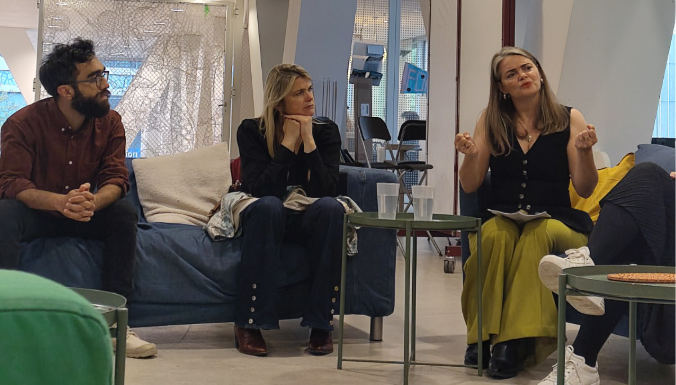
At the latest Fireside Peace Chats edition, we welcomed Elizabeth Molloy, an Irish gender and development consultant, living in Malawi, for a conversation on a question rarely asked about Malawi: what is the experience of women in a seemingly peaceful Malawi?
Elizabeth worked as educator, first in Ethiopia and then in Malawi, where she has now lived for 13 years and consults for the development sector. With around 80% of the population living in rural areas and no active conflict within its borders, Malawi has built a reputation as a peaceful country. Elizabeth shared the story that this reputation leaves out.
Gender-based violence remains a major problem in Malawi, with reports showing that around 40% of women experience some form of abuse in their lifetime. Elizabeth’s research focuses on polygamous households and the forms of violence found there. As the government has no legal framework to recognise these households, she argued, the women living in them are left in an even more precarious position.
She explained how cultural gender norms cast men as the sole providers. In a country with few opportunities for young men to work, violence, virility, and control over women can become a way to fulfil their masculinity. That masculinity may feel especially endangered if their wives begin to earn, and are seen to become financially independent. When designing any policy intervention to improve women’s economic position, work must be done to transform harmful social norms since making women independent providers may put them in an even bigger danger.
In response to experiences shared by the group, Elizabeth emphasised that the issue is intersectional, connected to a number of other social, economic and historical factors, such as prevalent social norms, poverty, and colonial legacy. However, any project aiming at improving position of women should, Elizabeth emphasizes, engage men, too. A study of joint decision-making in the groups she works with shows the gap in lived experience: 83% of men said decisions about food and clothing are made together, while only 50% of women agreed. Women’s solidarity is a powerful means of increasing women’s autonomy and there are solutions that women themselves have developed to support each other, such as mutual saving funds.
Blame for violence is also misplaced. Polygamy does not help this. “In every situation, women are blamed,” Elizabeth said. If a husband takes another wife, the first wife is assumed to have been the problem.
Although Malawi has reputation of a peaceful nation, the high incidence of intimate partner violence over women suggests a different picture. Elizabeth stimulated a nuanced discussion of this neglected problem, while also discussing how a conflict-sensitive international development can contribute to a positive change.
Fireside Peace Chats
The Fireside Peace Chats are a joint initiative between Leiden University College (LUC), The Knowledge Platform for Security and Rule of Law (KPSRL) and the Hague Humanity Hub (THHH). They aim to create space for practitioners to share the lived realities behind today’s peace and justice challenges. Thank you to Elizabeth Molloy for sharing her experience and research, and to everyone who joined us for this conversation.
1 Molloy, E., Chitika, A. and Mussa, D. (2016). Gender Analysis of Village Savings and Loans: Enhancing Community Resilience Programme (ECRP). Report for Christian Aid. C12 Consultants, Malawi.
