Help shape the Hub’s next chapter
We are evaluating eight years of the Humanity Hub, and we want your perspective. No more than five minutes, open until 23 October.
Take the survey
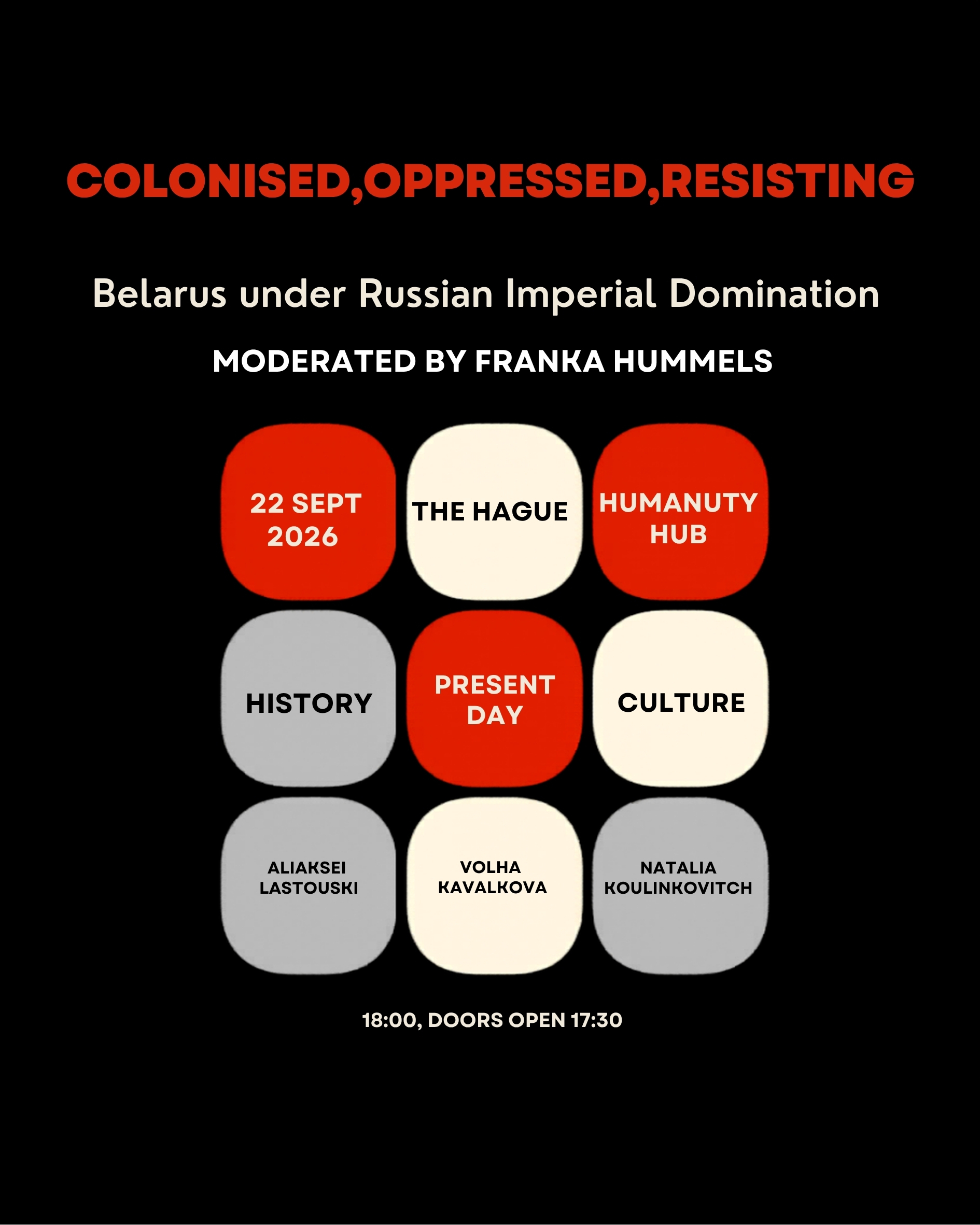
Belarus offers one of the clearest examples of how imperial domination shapes identity, language, and political life. For centuries, Belarusian autonomy, language, and culture have been systematically suppressed under Russian imperial rule, from the Russian Empire to the present day.
This programme explores the Belarusian experience not as a passive case, but as a history of resistance and survival. The event also invites reflection on how imperial narratives continue to
shape perceptions of the region today.
Through three short expert talks followed by a moderated discussion, the event will explore three perspectives: history, language and culture, and the contemporary situation.
➡️ Aliaksei Lastouski is Academic Director of the Belarusian Institute of Public History and one of the leading scholars on how historical memory has been weaponised against Belarus. Expelled from the country after the 2020 protests, he has continued his work in exile — including a Fulbright fellowship at Columbia University — researching how Russia is actively rewriting Belarusian history to serve the Kremlin’s agenda. He will speak on the long arc of imperial suppression.
➡️ Volha Kavalkova needs little introduction to anyone who followed the Belarusian uprising of 2020. A co-chair of the Belarusian Christian Democracy party and a member of the Coordination Council formed around presidential candidate Sviatlana Tsikhanouskaya, she was detained, briefly imprisoned, and ultimately forced across the Polish border in the middle of the night. Part of the opposition movement awarded the European Parliament’s Sakharov Prize, she now works in exile and will speak on Belarus today — what resistance looks like, and what is at stake.
➡️ Natalia Koulinkovitch is a Belarusian educator and cultural commentator whose work explores language, identity, and the everyday politics of culture under an authoritarian system. She will speak on what it means to keep a language and culture alive when the state actively works to erase them.
The discussion will be moderated by Franka Hummels, one of the Netherlands’ foremost experts on Belarus. A historian and freelance journalist who has been travelling to and reporting from Belarus for over twenty years, she writes for Vrij Nederland and works as an editor at Radio 1. Her book De Generatorgeneratie — about the generation that grew up in the shadow of Chernobyl — is a landmark work on the country.
The evening runs until 20:00, but we’re not stopping there. Stick around afterwards for drinks and informal networking.
This event is organized by Stichting FRNL and supported by REKA
From workshops and trainings to large conferences, our modern facilities — including hybrid options and sustainable catering — ensure a smooth experience. We also offer optional support with guest registration, check-in, ticketing, and event communications. Contact our team for a custom, no-obligation quote: