
Discussions in The Hague highlighted why ending fossil fuel dependence requires more than climate targets. It demands legal reform, equitable finance, inclusive governance and a fundamentally fairer transition.
Held at The Hague Humanity Hub on June 16, the discussion came at a pivotal moment for international climate diplomacy. Following the first Conference on Transitioning Away from Fossil Fuels (TAFF) earlier this year, governments, local communities, civil society and policymakers are beginning to grapple with a pressing question left largely unresolved: how to move beyond commitments to implementing a just transition away from fossil fuels.
Key Takeaways
- Transition roadmaps must be developed through meaningful participation by those most affected by a fossil fuel phase out.
- Climate ambition must be supported by legal frameworks that allow governments to phase out fossil fuels without exposing them to disproportionate legal risks.
- Transitioning away from fossil fuels requires adequate international financial support, especially for countries that depend on fossil fuel revenues.
- Sustained collaboration between governments, civil society and academia will be essential to turning international commitments into equitable action.

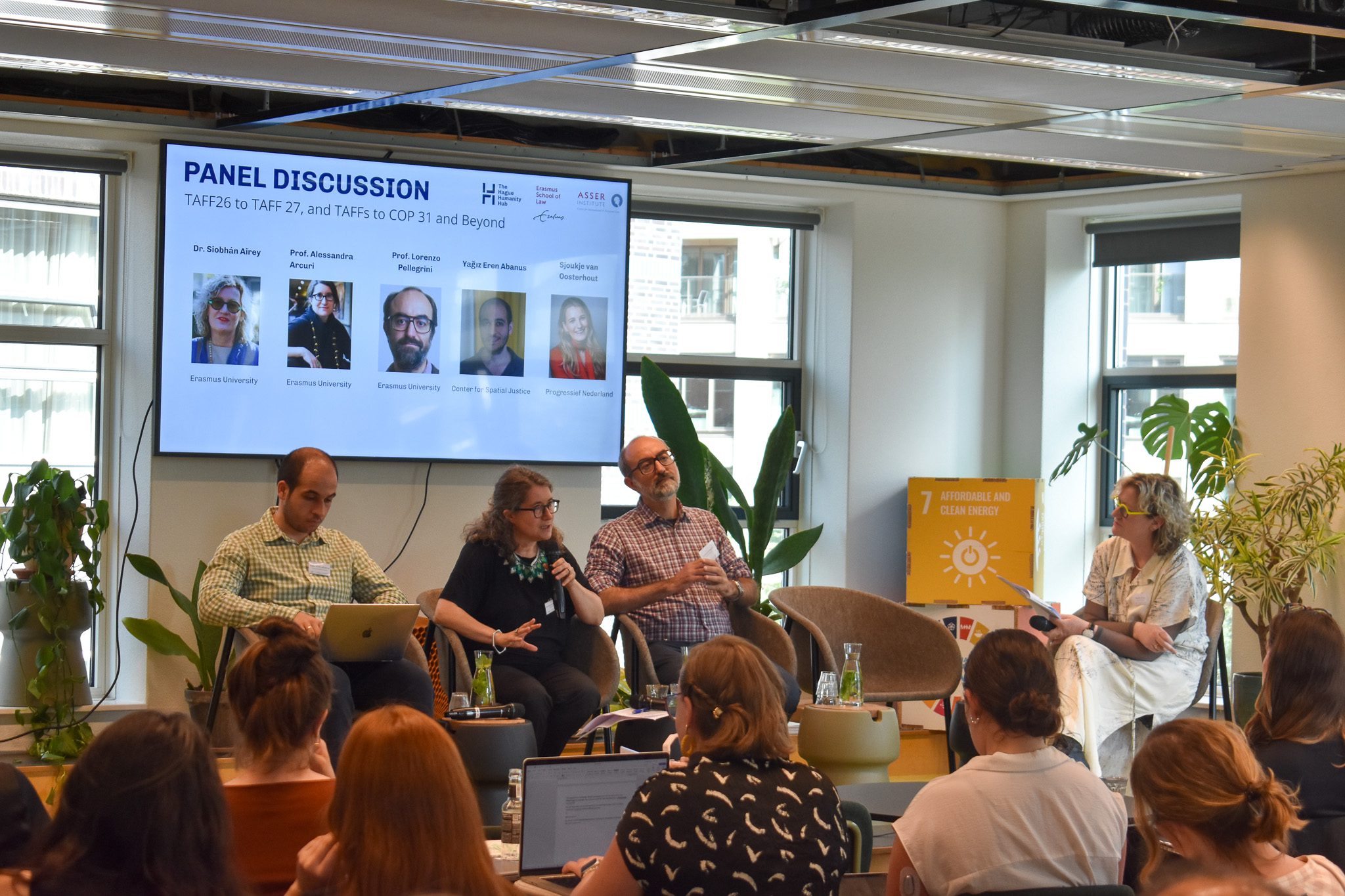
Over fifty academics, policymakers, civil society practitioners and government representatives gathered at The Hague Humanity Hub to reflect on the global energy transition and the outcomes of the first Conference on Transitioning Away from Fossil Fuels (TAFF).
Held earlier this April in Santa Mara, Colombia, the conference marked an important step in international cooperation on fossil fuel phase out. Co-hosted by the governments of Colombia and the Netherlands, the conference created space for voices that have often been underrepresented in international climate negotiations, including trade unions, Indigenous communities, sub-national governments and civil society organisations.
Following the momentum that galvanized in Santa Marta, the Erasmus School of Law, T.M.C. Asser Instituut and the Hague Humanity Hub co-organised a debrief event in The Hague to reflect on the outcomes and explore the road ahead.
As governments prepare for COP31 and future TAFF meetings, the focus must now shift from setting ambitious climate targets to addressing the practical barriers to a fossil fuel phase-out.

Transition Roadmaps Must Be Inclusive, Measurable and Tailored to National Contexts
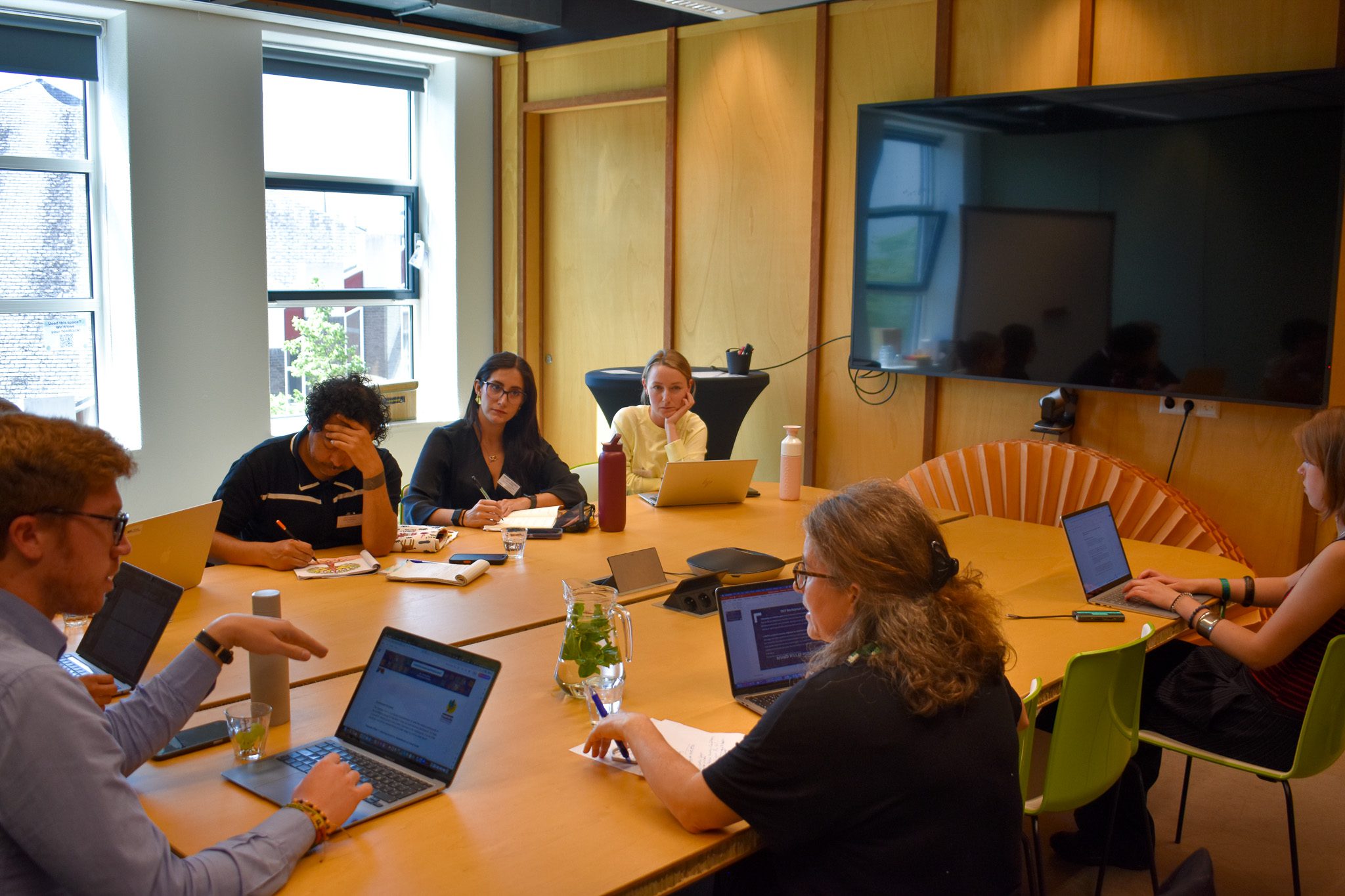
A central theme was how national and international roadmaps should and can be inclusively created by states in partnership with civil society. The discussions began by questioning what a transition roadmap should be, what its final objective is and how it can be made inclusive.
Participants agreed that roadmaps should move beyond broad ambitions and provide concrete, measurable steps for implementation. At the same time, it was recognised that no universal roadmap can be applied equally across all countries. Historical responsibility, levels of economic dependence on fossil fuel production, financial capacity and national circumstances all need to be taken into account.
Furthermore, discussions highlighted the importance of agreeing on clear indicators for measuring progress, assigning differentiated responsibilities and ensuring transparency throughout the transition process. Perhaps most importantly, participants argued that roadmaps should remain inclusive, respect human rights and be developed through ongoing dialogue between governments, civil society, researchers, workers and affected communities.
Legal Reform and Fair Finance Are Essential to Enable Climate Action
One of the strongest themes to emerge from the discussions was the hidden legal barriers to climate action, specifically Investor-State Dispute Settlement (ISDS). ISDS is a legal mechanism included in many international investment treaties that allows foreign investors, such as multinational corporations, to sue governments if they believe new laws or policies have unfairly harmed their investments. While these agreements were originally designed to protect foreign investment, participants argued that they can also make governments think twice before introducing ambitious climate policies.
Participants discussed how the financial risks associated with ISDS can create significant barriers to climate action. Governments, particularly those in the Global South, may face the prospect of costly legal claims simply for implementing ambitious climate policies, creating pressure to delay or weaken legislation. This includes policies focusing on phasing out fossil fuel production, cancelling extraction projects or introducing stricter environmental regulations. Even when governments ultimately win these cases, the high legal costs and uncertainty involved can discourage policymakers from pursuing ambitious climate action in the first place.
Beyond legal barriers, participants explored the broader financial architecture needed to support a just transition. Currently, many fossil fuel-producing countries rely heavily on revenues from oil, gas and coal extraction to finance public services. Transitioning away from fossil fuels therefore requires credible strategies to replace these sources of public income. Without adequate international financial support, countries with high economic dependence on fossil fuel production may face significant obstacles in pursuing ambitious phase-out policies.
More Attention Should be Placed on Tackling Fossil Fuel Production
In another discussion, it was noted that much of the current debate focuses on changing consumer behaviour and reducing demand for fossil fuels, while comparatively less attention is paid to the supply side of the economy. This includes international trade, investment agreements and the legal frameworks that shape energy production. Participants suggested that addressing these structural issues is essential if climate policies are to deliver meaningful emissions reductions.
Conversations also focused on how to decarbonise value chains and suggested that focusing on the relationship between consumers and producers provides a useful framework.
Interestingly, in the roadmap discussion, a key point was whether to focus on decarbonising or defossilising the economy. Several participants argued that focusing exclusively on greenhouse gas emissions overlooks many of the harms associated with fossil fuels, including toxic pollution, public health impacts and environmental degradation.
It was also noted that net-zero pathways may still permit substantial fossil fuel extraction and use.
“Net zero is not the same as ending fossil fuel dependence”
As a result, a key takeaway was that roadmaps should lead towards a defossilized economy, as net zero, overshoot and market solution narratives are not equitable solutions to the climate crisis.
A Just Transition Must Address Structural Inequality
During the debrief, it became clear that transitioning away from fossil fuels is more than reducing CO2 emissions. Trade union representatives emphasised that labour rights, social protection and economic security must be central to climate policy. Workers and communities whose livelihoods depend on fossil fuel industries cannot simply be expected to bear the brunt of transition alone. A just transition therefore means ensuring that climate action creates new opportunities while protecting those most affected by economic change.
Discussions also emphasised that the TAFF conferences must become more geographically inclusive. While Santa Marta successfully brought together many Latin American stakeholders, there was broad agreement that future conferences should strengthen participation from African and Asian trade unions and civil society organisations.
Finally, participants underscored that a just transition is not solely about replacing fossil fuels with cleaner technologies. Participants emphasised that existing patterns of extraction, unequal trade relationships and concentrated ownership of technology risk reproducing many of the same injustices in a low-carbon economy. Building local value chains, strengthening community participation and improving access to renewable technologies were therefore identified as essential components of a transition that is not only greener, but also more equitable.
A Just Transition Must Address Structural Inequality
During the debrief, it became clear that transitioning away from fossil fuels is more than reducing CO2 emissions. Trade union representatives emphasised that labour rights, social protection and economic security must be central to climate policy. Workers and communities whose livelihoods depend on fossil fuel industries cannot simply be expected to bear the brunt of transition alone. A just transition therefore means ensuring that climate action creates new opportunities while protecting those most affected by economic change.
Discussions also emphasised that the TAFF conferences must become more geographically inclusive. While Santa Marta successfully brought together many Latin American stakeholders, there was broad agreement that future conferences should strengthen participation from African and Asian trade unions and civil society organisations.
Finally, participants underscored that a just transition is not solely about replacing fossil fuels with cleaner technologies. Participants emphasised that existing patterns of extraction, unequal trade relationships and concentrated ownership of technology risk reproducing many of the same injustices in a low-carbon economy. Building local value chains, strengthening community participation and improving access to renewable technologies were therefore identified as essential components of a transition that is not only greener, but also more equitable.
The Road Ahead: COP31 and the Next TAFF Conferences
While participants offered constructive critiques of the Santa Marta process, the overall sentiment remained optimistic.
“There was a sense of hope and anticipation in Santa Marta.”
Many described Santa Marta as the beginning of a new chapter in international climate cooperation. The willingness of governments to create dedicated space for discussions on fossil fuel phase-out, outside the formal constraints of UN climate negotiations, was widely seen as an important breakthrough.
“Santa Marta shows that a fossil free space is possible. It is a starting point. Civil society in dialogue with government is something we need to cultivate. That is why we are here today: to continue that dialogue in a shared public space.”
With Ireland and Tuvalu expected to take forward the next TAFF conference, there was a shared commitment to build on the lessons learned and broaden participation across regions and sectors.
The discussions at The Hague Humanity Hub reinforced the message that achieving a just transition requires more than ambitious climate targets. It also requires legal systems that enable, rather than hinder, climate action, meaningful participation from those most affected by the transition, and continued collaboration between governments, civil society and academia.
As preparations continue for COP31, these conversations will remain essential. The challenge is no longer whether the world must transition away from fossil fuels, but whether international law, governance and institutions can evolve quickly enough to make that transition both effective and equitable.
Stay Informed about The Just Transition
The commitments on fossil fuel phase-out does not end here, you can engage in the dialogue further by:
- Reading our previous article on why ending fossil fuel dependence requires a new multilateralism here
- Exploring the work of The Hague’s Climate Justice Community and by subscribing to the newsletter here
- Joining upcoming events focused on sustainable transitions and international cooperation. Check our website for upcoming events here
- Connecting with civil society actors working on fossil fuel phase-out and climate justice ahead of COP31. Reach out to us via climate@humanityhub.org to connect and collaborate.
About the Event
Organized by Dr. Siobhán Airey and Prof Alessandra Arcuri, School of Law EUR; Dr. Stephanie Triefus, T.M.C. Asser Instituut; and the Hague Humanity Hub, this event took place on June 16, 2026 to reflect on the outcomes of Santa Marta and explore the road ahead.
Speakers included Prof. Elisa Morgera (UN Special Rapporteur of Climate Change and Human Rights), Sjoukje van Oosterhout (Member of Parliament, PRO), Josephine Ris(Senior policy officer Energy Saving, Ministry of Economic Affairs and Climate), (Dr. Daniel Chavez (Transnational Institute & University of the Basque Region), Dimple Sokartara-Pamudji (Mondiaal FNV), Fernando Hernandez (Head of Trade & Investment Policy, Both ENDS), Prof. Alessandra Arcuri (Erasmus University), Prof. Lorenzo Pellegrini (Erasmus University) and Yağız Eren Abanus (Center for Spatial Justice).
Furthermore, three workstream sessions were organised in the following themes:
- Co-creating inclusive transition roadmaps
Facilitated by: Dr. Stephanie Triefus (T.M.C. Asser Instituut) - Towards a more effective financial system to phase-out fossil fuels equitably
Facilitated by: Dr. Siobhán Airey (School of Law Erasmus University) - Thinking inclusively about the producer-consumer alignment in TAFF
Facilitated by: Prof. Alessandra Arcuri (School of Law Erasmus University)