

This year the overarching theme of the 10th edition of Impact Fest couldn’t be more relevant as the peace and justice ecosystem is under pressure. The threat of authoritarian regimes, increasing budget cuts and ongoing armed conflicts asks for unprecedented resilience and innovative change. Despite these turbulent times, the work on peace and justice must continue.
It’s not about how much you invest, but how and for whom
“We build today, even though it may be destroyed tomorrow,” said Jeroen Ketting, founder Lifeline Ukraine, during a session facilitated by The Hague Humanity Hub.
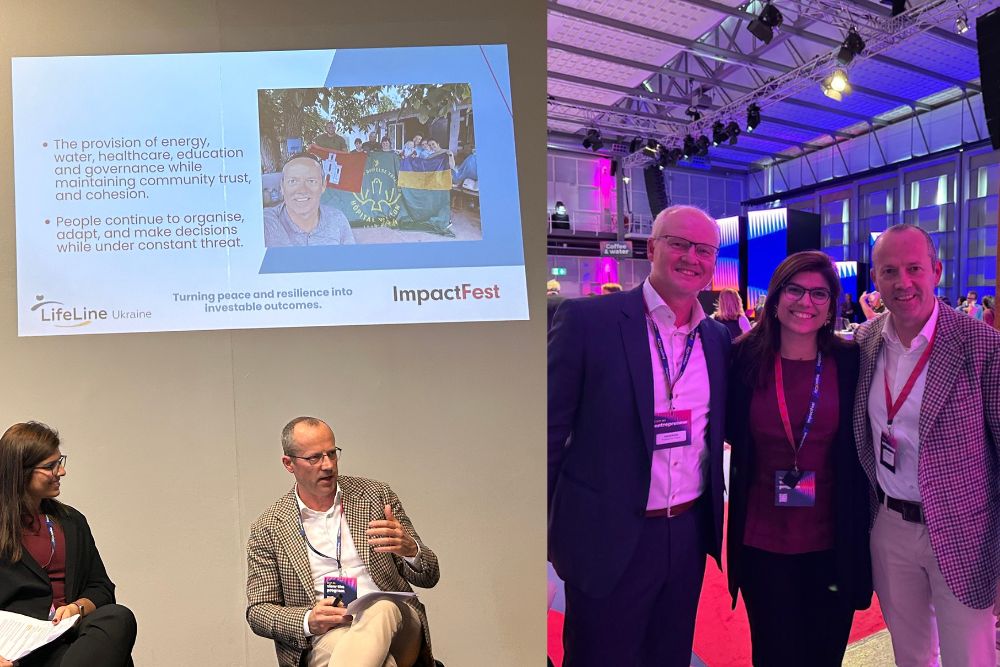
The session, moderated by our community programming manager Marcela Neves, explored with Jeroen Ketting from Lifeline Ukraine and Marcel Smits from Finance for Peace how strategic (and intentional) investments in peace can strengthen resilience. Smits stressed the need for innovative finance and smart strategies: “It’s not about how much you invest, it’s about how you invest and for whom.” He notices if you allocate capital where resilience is most needed, conflicts decrease and communities grow stronger.
Ketting adds how physical destruction is far easier to rebuild than human destruction. A destroyed building can easily be rebuilt unlike human capital and infrastructure. That’s why investing in frontline communities is key in rebuilding societies.
On the projector screen pops up a selfie from Ketting with frontline communities, showing how demand-driven aid and replicable projects help care and solve problems. It goes beyond just supplying, Lifeline Ukraine actively helps citizens, veterans, NGOs, small businesses, and communal infrastructure organisations in Eastern-Ukraine in their efforts to survive and thrive throughout and after the war.
A new standard and way of thinking
As Ketting works from the demand side, Smits is working with investment companies, banks and policymakers to develop a peace-generating investment framework, capable of highlighting innovative approaches to investments: “Often investments are approached from a risk perspective, however we also must look at the opportunity perspective.” Cases like Lifeline Ukraine show that peace-positive and conflict-sensitive investment models can align financial returns with stability, trust, and inclusive growth. “This new standard and way of thinking should be wider known, also among politicians,” someone from the very engaged audience responds.
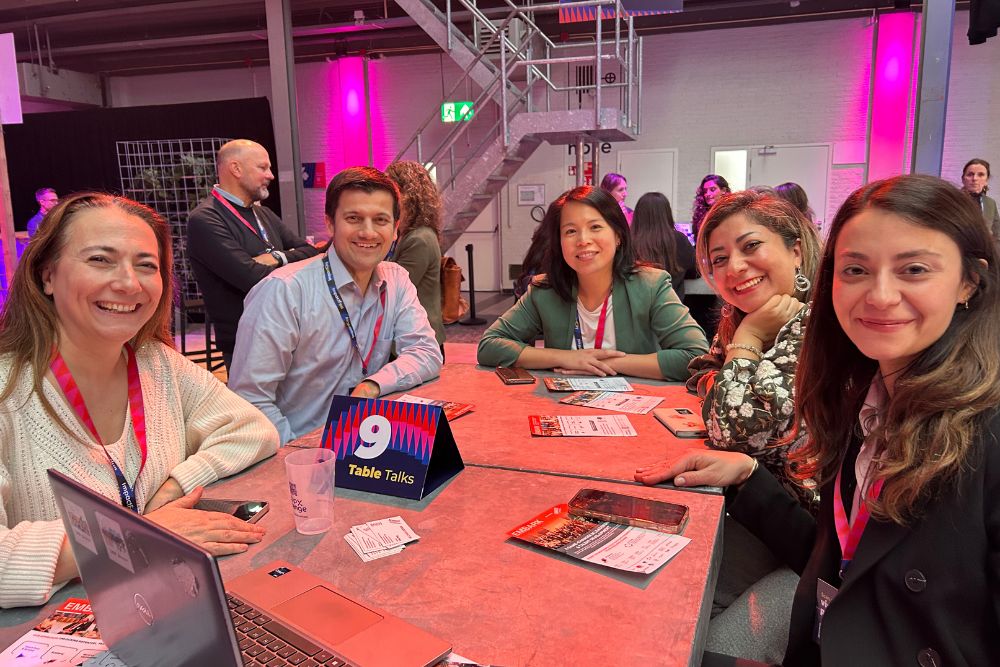
Investing in peace means investing in resilience, which is the way to recover from conflict. “Resilience isn’t about bouncing back; it’s also about bouncing forward,” emphasises Smits. This message also comes up during a Hub member’s Table Talk on reverse mentoring. Mikado Impact explains how their reverse mentoring programme with newcomers paves the way for a different kind of labour market. One where the younger one is the mentor, one where newcomers are welcomed as skilful individuals.
Nuha Boga, programme director of Mikado Impact, states “Voices are under pressure. We want to show how businesses can foster inclusive leadership and unlock fresh perspectives by tapping into newcomers’ lived experiences through reverse mentorship.”

Brace for impact
It was Sacha’s very first Impact Fest. Initially she was sceptical about the word impact, which often feels empty and is used at every turn these days. However, leaving inspired with new perspectives and tangible solutions, the Hub’s engagement at Impact Fest shows peace and justice work that is working. As long as we stay open to change our perceptions, embrace new perspectives, and lead in an inclusive and innovative way, the world will brace for impact.
I’m interested in a Peace Finance Workshop
Congratulations to Hub member, EviSafe for winning the Pels Rijcken Access to Justice Fund 2025 award at ImpactFest last week!

EviSafe is working to help victims of domestic violence access help in the moment where it’s needed, and document the abuse that is occurring through their app. The app detects sounds which may signal violence, and upon detection the app can automatically start recording, and/or send a message to alert trusted people (friends, family, or support services). Their work enables victims to get help in an accessible way, and improves the chances a case will be taken to court due to the increased evidence base.
We are proud to have members such as EviSafe who are working to improve victims’ safety and access to justice. Congratulations!