Help shape the Hub’s next chapter
We are evaluating eight years of the Humanity Hub, and we want your perspective. No more than five minutes, open until 23 October.
Take the survey27 October, 2026
From growing up under apartheid to defending international justice, the South African jurist’s Nobel Peace Prize comes as the US escalates its campaign against the International Criminal Court.
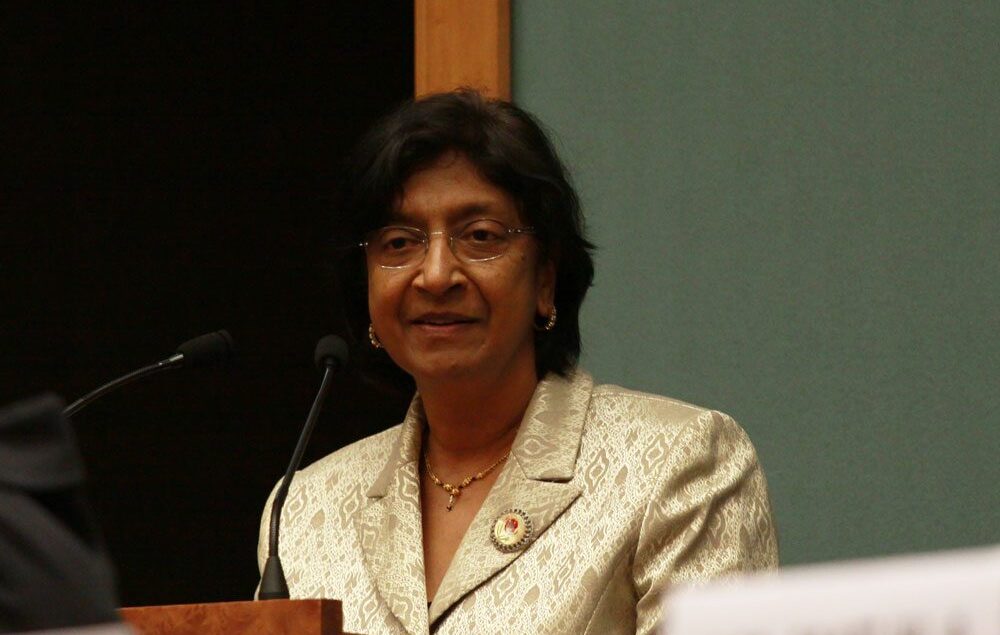
Photo: Eric Bridiers / U.S. Mission Geneva, via Wikimedia Commons (CC BY 2.0). Cropped from original.
“If you clap a little bit more, I may share the prize with Trump”, Navi Pillay joked when she learned she had been awarded the Nobel Peace Prize while attending a conference at the Nuremberg courthouse in Germany. Hours later, U.S. President Donald Trump made good on a long-standing threat: sanctioning the International Criminal Court (ICC). Pillay herself linked the move to the Nobel Committee’s decision, suggesting that Trump’s frustration at not receiving the prize had played a role.Trump has repeatedly told reporters that he is the only deserving recipient of the award. A similar exclamation led to last year’s laureate, Maria Corina Machado, handing over her prize medal to him.
The confrontation between Washington and the ICC predates this Nobel Prize by years, and for Pillay the sanctions represent something troubling: an attack on an institution that embodies the principles of international justice she has spent decades defending.
A South African human rights lawyer, Pillay has served as the UN High Commissioner for Human Rights, a judge at both the ICC and the International Criminal Tribunal for Rwanda, and chair of the UN Independent International Commission of Inquiry on the Occupied Palestinian Territory. She currently serves as an ad hoc judge at the International Court of Justice (ICJ).
Trump’s disdain for the ICC, and international law more broadly, is not new. Individual judges and prosecutors are sanctioned by the US, and relations between Washington and the court have been difficult since its inception. Sanctioning the ICC as an institution, however, is a drastic escalation.
US Secretary of State, Marco Rubio, said the measures aim to cut off the court’s resources and cripple its ability to operate against the United States. When they fully come into effect the court will no longer be able to use American banking and technology, on which, like much of the world, it relies heavily. “The sanctions affect all the court’s staff”, Pillay stressed. She travelled from Nuremberg straight to The Hague to show solidarity with her former colleagues, telling Democracy Now! she was deeply shocked the US administration would take this step.
Dutch Prime Minister Rob Jetten wants to use the six-month window before the sanctions take full effect to negotiate reforms to the ICC with Washington. In an interview with AFP, Pillay calls this idea “euphemistic”. Such reforms will likely exclude the US citizens from the court’s investigations, she warns, setting a dangerous precedent. The court cannot apply one standard of justice to some people and another to others. For Pillay, the irony of the US position is difficult to ignore.
Her connection to international justice began long before she entered a courtroom in The Hague. It began in South Africa, under Apartheid. Navanethem “Navi” Pillay was born in Durban in 1941 into an Indian Tamil family. Growing up under Apartheid meant encountering discrimination early and, wanting to understand her rights, she set her sights on studying law. When her school principal recognised her potential, members of her community pooled money to send her to university.
As a non-white student, Pillay had to attend university in separate facilities, spending her days in a former potato warehouse. It was there, high up on a shelf, that she found copies of the Nuremberg judgements, which no one else seemed to have touched. That discovery began her fascination with international justice. The laws surrounding her were immoral, and the Nuremberg trials showed her a system of law with values behind it.
Not letting herself be held back in a country in which she herself experienced limited rights, Pillay started her own law practice in 1967. She defended anti-apartheid activists and won due process rights for inmates on Robben Island. In 1995, after Nelson Mandela became president, he appointed her to the High Court, as its first woman of colour.
Decades later, she found herself in Nuremberg’s Courtroom 600 when the news of her Nobel Prize arrived. “Perhaps it was meant to be” she said. Pillay has pointed to the leading role the United States played in establishing the Nuremberg trials after the Second World War. The trials helped establish the principle that those responsible for the gravest international crimes could be held accountable under the law. That is why she finds it so troubling that the US is now sanctioning the ICC.
The Nobel Committee cited that same commitment to legal accountability. Its chair, Jørgen Watne Frydnes, said Pillay has been instrumental in ensuring war crimes, crimes against humanity and genocide are prosecuted. The Israeli foreign ministry responded angrily to the award, accusing the Nobel Committee of “rewarding the biggest lie of the 21st century.” It was her role as the chair of the UN Independent International Commission of Inquiry on the Occupied Palestinian Territory that elicited such a strong reaction. The report concluded that Israel is committing genocide in Gaza, a finding that Israel rejects. For Pillay, the question is not whether the findings of an investigation are politically convenient, but whether they are grounded in evidence and whether the same legal standards are applied to everyone.
By selecting her, the Committee said it wanted to issue a reminder at a time when judges and institutions of international law are under political attack. It warns of a shift towards “power politics at the expense of legal frameworks and global respect for law and justice. Whenever might overtakes right, it undermines stability, trust, and peaceful coexistence.”
The wider picture supports this concern. The Hague’s Asser Institute notes that the number of armed conflicts worldwide is at its highest level since 1946, while protections under international humanitarian law are increasingly treated as optional, obscured, misused and even weaponised.
The award is a reminder that international justice depends not only on legal institutions, but also on the people willing to defend them. Yet, those institutions face growing political pressure, and their ability to operate depends on whether states respect their independence, regardless of whether they agree with their decisions.
At 85, Pillay is not looking to slowing down. She told RFI, “I was hoping to retire. It’s such a temptation […]. But it’s even shameful to raise our own little personal irritations when the world needs you. So as long as I’m needed, I will continue to function in the manner that I have been doing.” She has said she wants to use the roughly $1.2 million in prize money to support education for children and young people in her home country of South Africa.
Authored by Naomi Suchland
