

Democratic change does not begin and end at the ballot box. Across the Western Balkans, young people are challenging political systems they see as unaccountable, demanding transparency and questioning whose interests governments serve. But turning public mobilization into lasting change remains a difficult task.
In Serbia, a student-led movement has translated years of protest into an electoral breakthrough. In Albania, protests that began around a controversial investment project have grown into broader demands concerning corruption, education and political accountability. Although the two movements are at different stages, both raise a fundamental question: what does it take for citizens to turn demands for change into a more accountable political system?
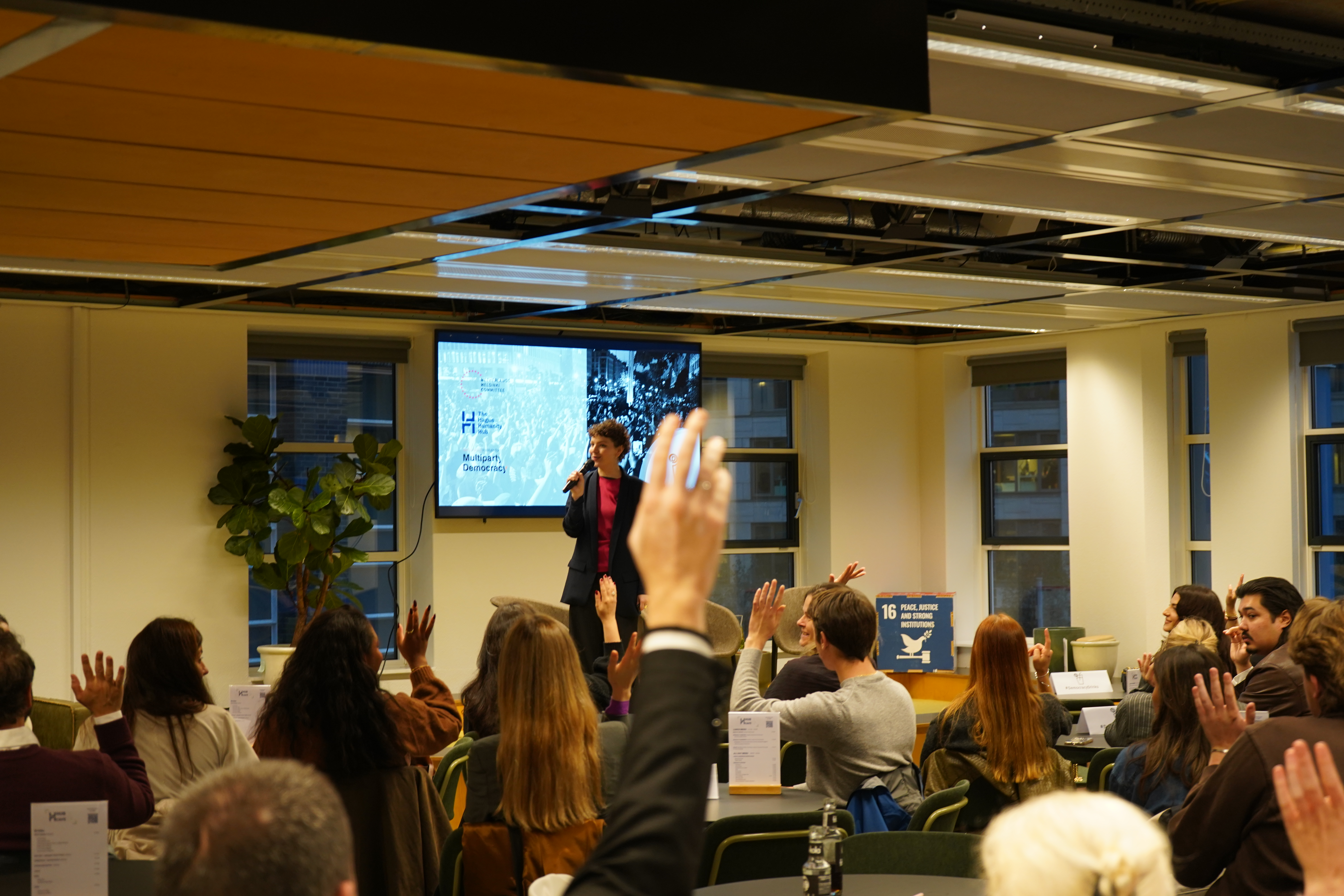
At the 27 October edition of #DemocracyDrinks at The Hague Humanity Hub, two students from the region, Maša Vujasinović from Serbia and Lorisa Haxhijaj from Albania, shared their perspectives on these developments. The conversation explored the role of young people, the limits of formal political opposition, the European Union’s influence and the possibilities for greater solidarity across the region.
Key insights
- A specific incident can expose a much deeper problem. Protests in Serbia and Albania began around different issues but grew into broader challenges to political power and accountability.
- Public mobilization needs a path towards institutional change. Protests can challenge those in power, but lasting change depends on accountable institutions, transparent decision-making and the ability to translate public demands into reforms.
- Young people are challenging established political structures. Serbia’s student-led movement has sought to organise around collective expertise rather than a single leader. In Albania, students have joined an existing protest movement with demands extending beyond its original environmental concerns.
- Democratic participation is about more than elections. Independent media, civic engagement, peaceful protest and public scrutiny are essential to holding political leaders accountable between elections.
- Regional solidarity can transcend historical divisions. Despite the region’s complex history, the speakers highlighted shared concerns about corruption and the desire for young people to build a future in their own countries.
Discussion highlights
1. When a single incident becomes a demand for systemic change
Protests in Serbia and Albania began around different issues but grew into broader challenges to political power and accountability.
In Serbia, the November 2024 Novi Sad railway station canopy collapse sparked a student-led movement demanding transparency and accountability, reflecting wider concerns about corruption, government oversight and access to information. Maša Vujasinović highlighted the need for access to construction documents and noted early signs of change in the media landscape,noting that a government-aligned media outlet had apologized for its previous bias.
In Albania, the Flamingo movement began over an investment project linked to a protected natural area. As students joined, demands expanded to education costs, limited opportunities and concerns about corruption.
In both countries, a specific issue became a symbol of deeper dissatisfaction with how political decisions are made and power is exercised.
2. From public pressure to accountable institutions
Mobilizing citizens is one challenge, ensuring that their demands lead to lasting change is another.
Serbia’s student-led movement has attempted to address this by developing an electoral list through a collective process involving people from different professional backgrounds. Rather than placing a single figure at the centre, the initiative has emphasized expertise and cooperation.
Albania presents a different challenge. Lorisa Haxhijaj described how frustration grew after Prime Minister Edi Rama indicated that even very large demonstrations would not lead him to resign. While she did not endorse violence against property, she acknowledged the anger behind the protests.
“I do understand their rage, where their rage is coming from.”
3. Can a shared democratic future overcome historical divisions?
The audience discussion brought a regional perspective to the conversation. The speakers emphasised the possibility of cooperation across national boundaries. Haxhijaj, who is from Kosovo, spoke about the importance of young people supporting one another despite the difficult relations between their countries.
“We as Balkan people, we want them to have a better future in their own country.”
Both speakers identified corruption as a shared concern that could provide a basis for cooperation. This does not erase historical differences or remove the need for accountability. Rather, it suggests that regional solidarity can develop alongside honest engagement with the past.
Why this matters
For the peace and justice community in The Hague, developments in the Western Balkans offer an important reminder that democracy is not only a matter of institutions and elections. It also depends on civic participation, access to information, public trust and the ability of societies to hold those in power accountable.
The discussion also demonstrated the value of creating space for young people to speak about political developments in their own countries. Their perspectives can help connect international policy debates with the lived experiences of citizens, particularly when questions of democracy, corruption and political representation are often discussed through institutional or geopolitical lenses.
About the event
#Democracy Drinks The Hague is a regular event series that brings together professionals, researchers, policymakers, and civil society actors to discuss pressing issues related to democracy and the rule of law.
#DemocracyDrinks: Political Developments in the Western Balkans took place on 27 October 2026 at The Hague Humanity Hub in The Hague.
The discussion featured Maša Vujasinović from Serbia and Lorisa Haxhijaj from Albania, both students at the University of Ljubljana, and was moderated by Emiel Bongaerts from PRO International.
The event was organised in collaboration with PRO International, NSDE, the Netherlands Helsinki Committee (NHC), PAX and the Albanians in the NL Foundation. It formed part of the recurring #DemocracyDrinks series, which brings together people interested in democracy, peace, justice and democratic participation for open discussion and networking.
The series is coordinated by the Netherlands Institute for Multiparty Democracy (NIMD), the Netherlands Helsinki Committee (NHC), and The Hague Humanity Hub, and regularly partners with organisations across the peace, justice, and democracy ecosystem.
Do you want to take action to defend democracy at home and abroad? Host a #DemocracyDrinks edition! Learn more about the Democracy and Rule of Law Collective