Help shape the Hub’s next chapter
We are evaluating eight years of the Humanity Hub, and we want your perspective. No more than five minutes, open until 23 October.
Take the survey6 October, 2026

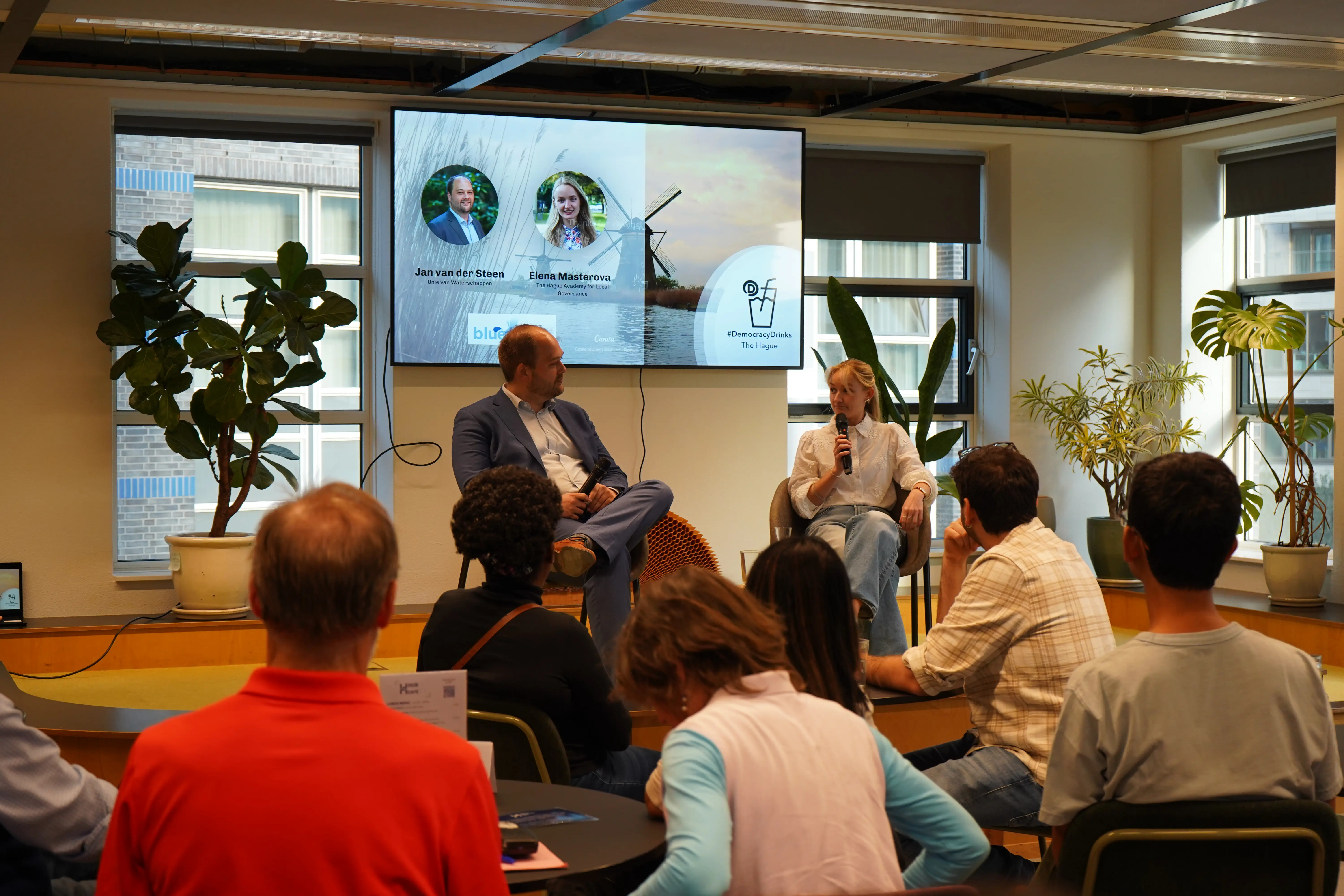
“Water choices can be very political.”
Water is often treated as a technical issue: how much is available, how to manage it and how to keep it clean. But as drought and water scarcity put increasing pressure on the Netherlands, decisions about water increasingly involve choices between competing interests.
At this edition of #DemocracyDrinks in collaboration with Blue Drinks, we explored what those choices mean for democratic decision-making: from how water is shared and who pays for its management, to how local decisions connect to wider European water systems.
1. Water scarcity makes political choices harder to avoid
When water is abundant, decisions about its distribution can seem largely technical. Scarcity makes the trade-offs more visible. Should groundwater levels prioritize agriculture or nature? Should wastewater be treated only to the legal minimum, or further to protect ecosystems? And who should pay for the additional costs? Water connects people with different interests, and managing it requires them to find ways of working together.
As speaker Jan van der Steen noted, “water choices can be very political.”
2. The challenge is shifting from managing excess water to retaining it
For much of Dutch history, water management focused on getting rid of excess water, draining land, controlling water levels and protecting against floods.
Drought is adding another challenge: how to hold on to water. Storing and reusing water are becoming increasingly important, raising practical questions about where water should be kept and how it should be allocated when supplies are limited.
3. Democratic participation depends on people knowing what institutions do
The Netherlands has elected water boards, but many residents are unfamiliar with their role, what water taxes fund, or the fact that they can vote in water-board elections.
This raises a simple but important question: what happens when democratic institutions are in place, but their role in everyday life is not well understood?
4. Water governance cannot stop at administrative borders
Water may be managed locally and regionally, but it does not follow those boundaries. The Netherlands sits downstream in several major European river basins, so decisions made elsewhere can affect both water quality and availability here.
Issues such as river management and chemical pollution, including PFAS, therefore require cooperation between municipalities, regions, national governments, and European neighbors.
Who gets the water?
One of the central questions was how to balance competing claims on a limited resource. Agriculture, nature, households, industry, and energy can all depend on the same water system. As climate change puts more pressure on supplies, decisions about allocation become harder to avoid, and harder to leave to technical experts alone.
The discussion highlighted that there is no simple way to satisfy every interest at the same time. Choices about priorities and responsibilities need to be made openly and transparently.
Who pays for water risks?
Water quality also comes with a financial question. Removing pollutants such as PFAS can require significant investment, raising the question of whether those costs should fall on the public or on those responsible for the pollution.
The “polluter pays” principle provided one way into this discussion, but it also raised wider questions about fairness, responsibility and public trust.
Can we cooperate before scarcity becomes a crisis?
Another theme was timing. Once water becomes scarce, different users have stronger reasons to protect their own access. Agreeing on priorities and responsibilities before that point may therefore be crucial.
The challenge is not only developing the right technical solutions but also creating conditions for different interests to agree on how those solutions should be used.
Water makes questions about governance particularly tangible. There is a shared resource, different groups that depend on it, and difficult choices about how risks and costs should be distributed.
For The Hague and the wider peace and justice ecosystem, these questions also point to the importance of cooperation across institutions and borders. Water does not stop at a municipal or national boundary, making coordination and the ability to reach agreements between different interests as an essential part of managing shared resources.
The discussion offered a reminder that climate adaptation is not only about infrastructure. It also depends on the institutions, cooperation, and public participation needed to make decisions about increasingly limited resources.
#Democracy Drinks The Hague is a regular event series that brings together professionals, researchers, policymakers, and civil society actors to discuss pressing issues related to democracy and the rule of law.
The September edition on Local Democratic Water Management was organised in collaboration with Blue Drinks Netherlands. Blue Drinks Netherlands is an informal networking event series for water, environment and sustainability professionals, hosted in The Hague and across the Netherlands. Blue Drinks aims to bring people together, stimulate conversation, and strengthen the connections between people in the water sector. Each event is unique in terms of theme, venue, partner and invited speakers who discuss issues related to water from a diverse array of backgrounds and perspectives.
The series is coordinated by the Netherlands Institute for Multiparty Democracy (NIMD), the Netherlands Helsinki Committee (NHC), and The Hague Humanity Hub, and regularly partners with organisations across the peace, justice, and democracy ecosystem.
Do you want to take action to defend democracy at home and abroad? Host a #DemocracyDrinks edition! Learn more about the Democracy and Rule of Law Collective
