Help shape the Hub’s next chapter
We are evaluating eight years of the Humanity Hub, and we want your perspective. No more than five minutes, open until 23 October.
Take the survey7 July, 2026
Explore how recent political developments intersect with questions of sovereignty, democratic legitimacy, accountability, and human rights.

Six months after the U.S.-led operation that removed Nicolás Maduro from office, Venezuela’s political future remains deeply contested. While some international actors describe the current period as a democratic transition, many of the country’s institutions, power structures, and patterns of repression remain largely unchanged. This has fueled growing debate over whether Venezuela is experiencing a genuine democratic opening or a new form of externally managed governance.
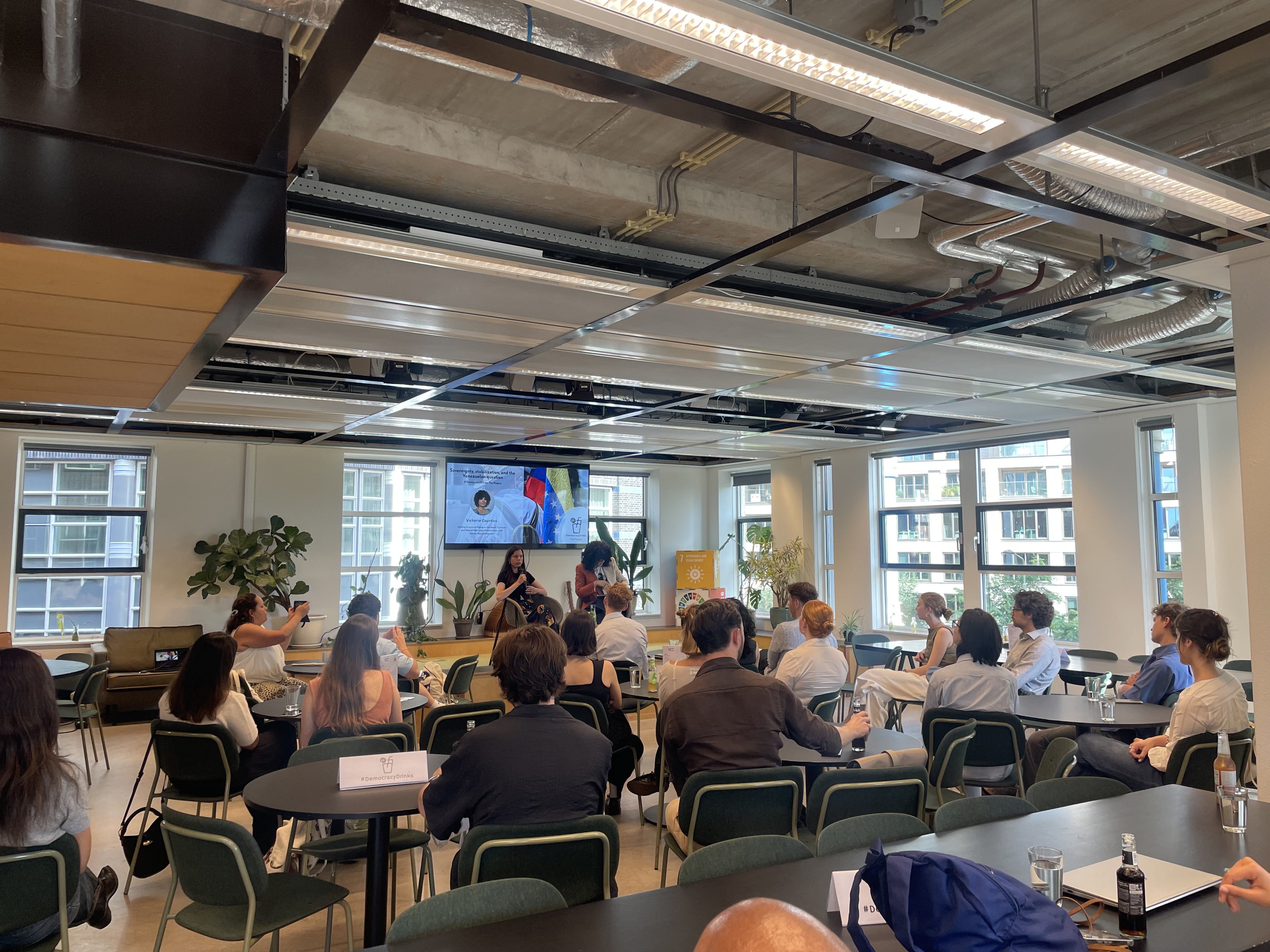
This edition of #DemocracyDrinks explored how recent political developments intersect with questions of sovereignty, democratic legitimacy, accountability, and human rights. Guest speaker Victoria Capriles together with Cecilia Rivero examined what these shifts mean for Venezuelan society and whether current reforms are laying the foundations for democracy or simply reshaping how power is exercised.
Key Insights
Discussion Highlights
Democratic transition or externally managed governance?
Although Venezuela’s political landscape has shifted significantly since January, the underlying structures of power remain largely intact. Renewed engagement between the United States and the Rodríguez interim government has reshaped regional politics, yet these geopolitical developments have produced few tangible improvements for ordinary Venezuelans. The country’s repressive apparatus continues to operate; humanitarian needs remain immense, and the absence of reliable official data makes independent monitoring increasingly important. Public confidence in the interim presidency remains extremely low, reinforcing concerns about political legitimacy and the distance between institutional change and democratic transformation.
The uncertainty surrounding Venezuela’s future reflects a broader question: when does political change become genuine democratic transition, and when does it simply redistribute power under new conditions?
Human rights and political prisoners remain at the center
The continued detention of political prisoners remains one of the clearest indicators that democratic reform is incomplete. Although hundreds of political prisoners have been released since January 3, many still do not have full freedom due to precautionary measures, and nearly six hundred others remain imprisoned.
Political persecution extends well beyond opposition leaders. Ordinary citizens have been detained for expressing criticism online, questioning election outcomes, or because of their relationships with politically active family members. At the same time, families, particularly mothers and wives, have carried much of the burden of advocating for their loved ones, often at significant emotional and personal cost.
Questions also remain about the effectiveness of the Amnesty Law for Democratic Coexistence introduced earlier this year. Limited public confidence and concerns about its narrow scope have raised doubts about whether it represents meaningful accountability or simply a symbolic gesture that leaves many victims without justice.
Natural resources, transparency, and competing priorities
Venezuela’s vast oil reserves have once again become central to international engagement. Recent legislative reforms have opened the sector to greater foreign investment, creating opportunities for economic recovery after years of decline.
Yet economic liberalisation has not been matched by greater transparency or stronger institutions. Questions persist over how oil revenues are managed, who benefit from new investment, and what mechanisms exist to ensure public accountability. Despite possessing some of the world’s largest energy reserves, many Venezuelans continue to face fuel shortages, poverty, and widespread humanitarian hardship.
These developments highlight the tension between geopolitical interests and democratic governance. Economic recovery may prove essential for Venezuela’s future, but without transparency, accountability, and inclusive institutions, renewed investment alone is unlikely to restore public trust.
Why This Matters
Venezuela illustrates the complexity of democratic transitions in contexts shaped by prolonged authoritarianism, humanitarian crisis, and competing international interests. Political change, on its own, does not guarantee democratic governance. Lasting transformation depends on accountable institutions, the protection of human rights, transparent decision-making, and the meaningful participation of civil society.
For The Hague, as the International City of Peace and Justice, these questions resonate strongly. Venezuela has been under investigation by the International Criminal Court since 2018 for alleged crimes against humanity, underscoring the continued importance of international justice alongside efforts to strengthen democracy and the rule of law.
Since this discussion took place, the humanitarian situation has deteriorated further. The twin earthquakes that struck Caracas and five states on June 24, the day after the event, have claimed thousands of lives and intensified urgent humanitarian needs for millions. If you would like to support those affected, you can contribute through unicef.nl.
About Democracy Drinks The Hague
Democracy Drinks The Hague is a regular event series that brings together professionals, researchers, policymakers, and civil society actors to discuss pressing issues related to democracy and the rule of law.
The series is coordinated by the Netherlands Institute for Multiparty Democracy (NIMD), the Netherlands Helsinki Committee (NHC), and The Hague Humanity Hub, and regularly partners with organisations across the peace, justice, and democracy ecosystem.
Do you want to take action to defend democracy at home and abroad? Host a #DemocracyDrinks edition! Learn more about the Democracy and Rule of Law Collective
