


“When the world talks about peace and security, we don’t see ourselves. We watch the news and read the reports, we don’t see ourselves. We walk into global spaces, we don’t see ourselves. Not our language, not our culture, not our stories.”
—
Congratulations on winning the Youth Carnegie Peace Prize! Could you first introduce yourself and tell me what it means to you to win this prize?
My name is Galia Kademián, I’m from Argentina, 24 years old, and I’m a lawyer. Winning the Youth Carnegie Peace Prize is an honour and at the same time a surprise. As an Argentinian and daughter of democracy, I take this milestone as a continuous personal responsibility to forever uphold the demands of memory, truth and justice.
But this prize represents a more powerful message that we matter: that young peacebuilders, our stories, our struggles and our solutions, belong at the heart of global peace and security.
“Whether it’s fostering social-emotional skills in Argentina, preventing school dropouts in Honduras, tackling bullying in Chile, or addressing gender-based violence across Latin America.”
The Americas’ Youth Advocacy Team is quite new – May 2024. How did it come into being?
As I said in my acceptance speech, we feel that our stories and narratives are not represented and heard. The work around Youth, Peace and Security (YPS) Agenda is detached from our realities, in contrast to other regions.
We understood that it was necessary to advance youth, peace and security, we must be better connected in a strategic, comprehensive and organised way in the Americas.
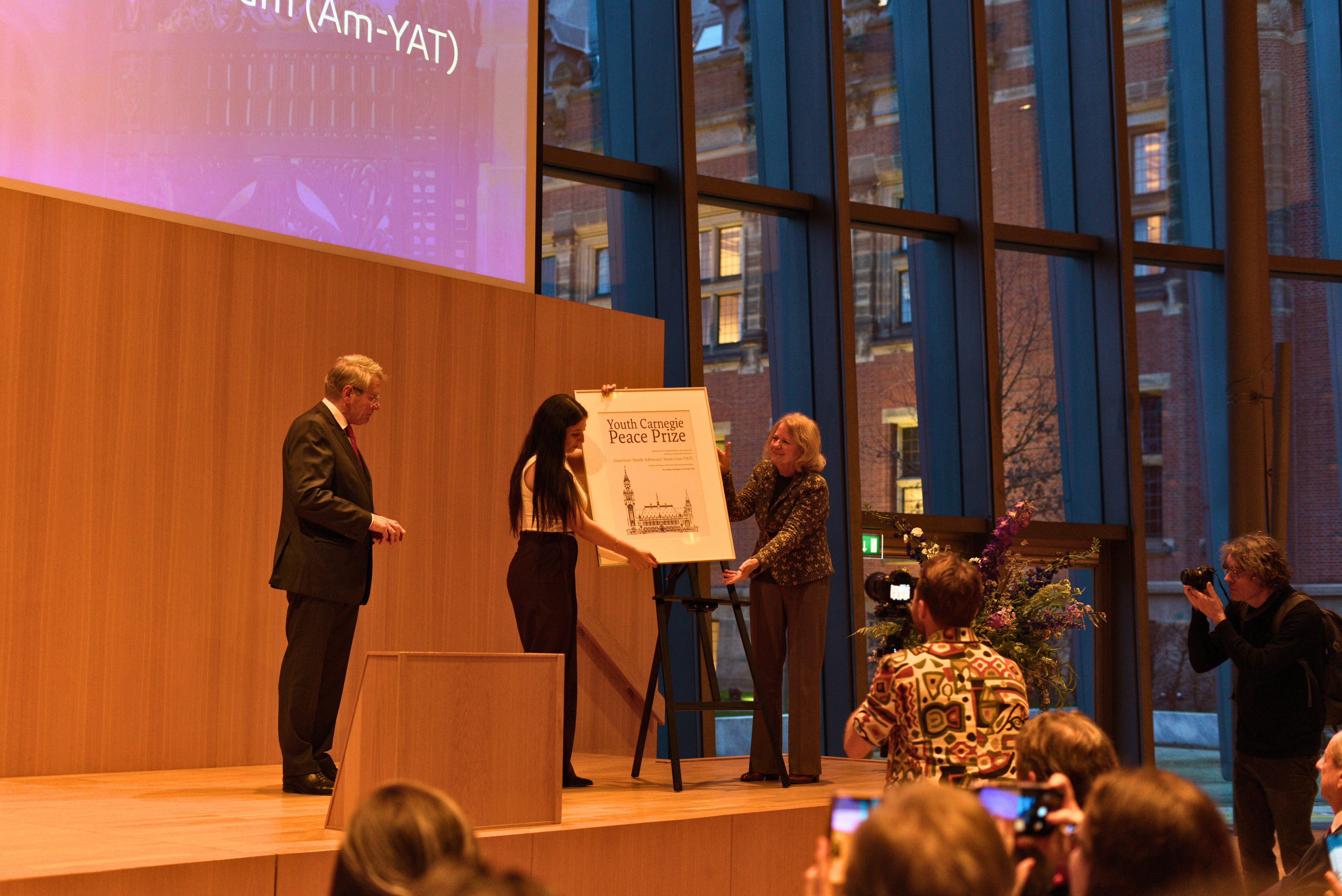
Sacha Verheij/The Hague Humanity Hub: Galia Kademián accepting the award.
The jury explains why Am-YAT won the prize as follows: “Working on peace can sometimes feel abstract, and analysing numbers and statistics can seem like a dry subject. The young people of the Americas’ Youth Advocacy Team know how to bring ideas and numbers to life in everyday experience.” Can you give some examples?
The AM-YAT consists of 25 young people from 16 youth-led organisations. We bring ideas and numbers to life through grassroots initiatives. Whether it’s fostering social-emotional skills in Argentina, preventing school dropouts in Honduras, tackling bullying in Chile, or addressing gender-based violence across Latin America.
The Millennial Movement in Perú is merging peace and art to achieve the sustainable development goals, Jolu de Guatemala presented a bill to Congress to address the mental health crisis of young people, and the Canadian Coalition on YPS is using research and advocacy to fight tokenism.
As you can see, our focus varies a lot, but we all have a common denominator: our mission to build peace.
“Actively building peace can be very diverse; there are many ways in which peacebuilding can be done.”
What are some of the main challenges you face and how do you overcome them?
The first barrier was about self-confidence, believing that our work is valuable. Because we work from the grassroots, we are often unaware of how important our voice is for the global agenda.
Secondly, seeing ourselves as peacebuilders. Because of the diversity within peacebuilding, we use different terms; but the term ‘peacebuilder’ sometimes feels strange. Understanding the terminology, engaging in conversation. Actively building peace can be very diverse; there are many ways in which peacebuilding can be done.
Thirdly, we feel a lack of political and international bodies, while Europe has the EU, Africa the AU, and the Americas the AOS. It is a challenge to work within the UN structure and infrastructure for peacebuilding; there is a geographical and architectural barrier.
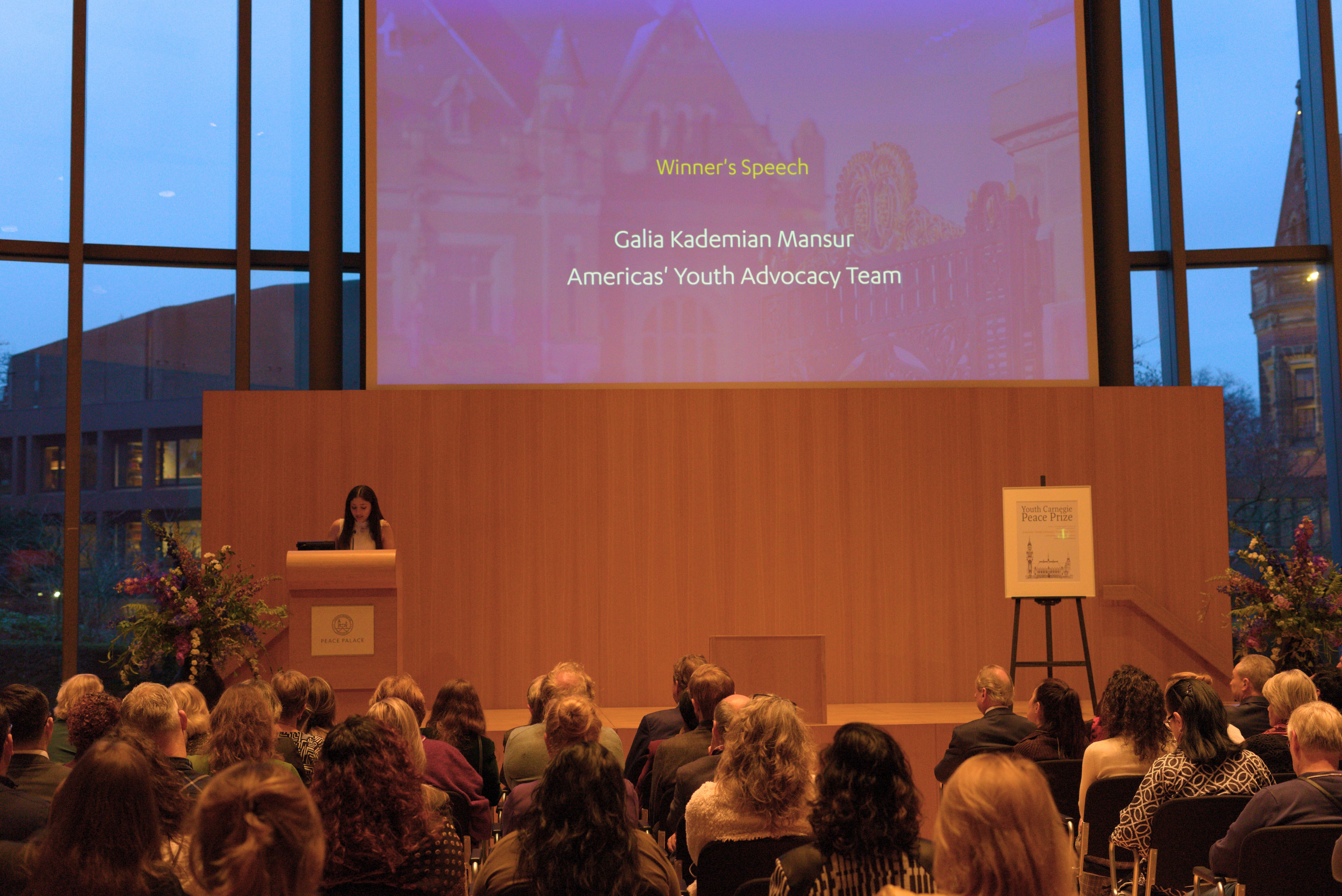
Sacha Verheij/The Hague Humanity Hub: Galia Kademián delivering her acceptance speech.
“Young people, we don’t conform to the historical excuses for the world’s recurring problems. Those excuses don’t apply to us.”
What has been the highlight of your work so far?
The launch of Catalyst for Change, which won the prize. It’s a comprehensive report released in May 2025. All Am-YAT members worked together to gather data on how youth-led organizations are building peace, how we address the challenges, and the various activities we undertake. It was entirely volunteer-driven and it’s already making an impact with policymakers.
What can older generations learn from your generation?
Resilience and creativity. Young people, we don’t conform to the historical excuses for the world’s recurring problems. Those excuses don’t apply to us. We are extremely resilient, not only in the face of current problems, but also in the face of what’s to come.
We strive to renew our strategies and our efforts every day. Creativity in collaboration. What can we learn from this? The sense of solidarity, the sense of playfulness, which temporarily sets aside the responsibility and seriousness of everything, that’s what keeps us together.
“To anyone feeling overwhelmed by global crises: start by finding a community. Safety and action begin with connection.”
People, young and old, often feel overwhelmed by the current state of the world (fe. Gaza, Sudan, Yemen, Congo, Philippines, US, Ukraine and so on). However, they often want to do something but don’t know where to start. What would you say to those people?
To anyone feeling overwhelmed by global crises: start by finding a community. Whether that is a digital or physical space. Safety and action begin with connection. Identify what matters most to you, join others who share that passion, and take the first step toward becoming a catalyst for change.
What is the end goal?
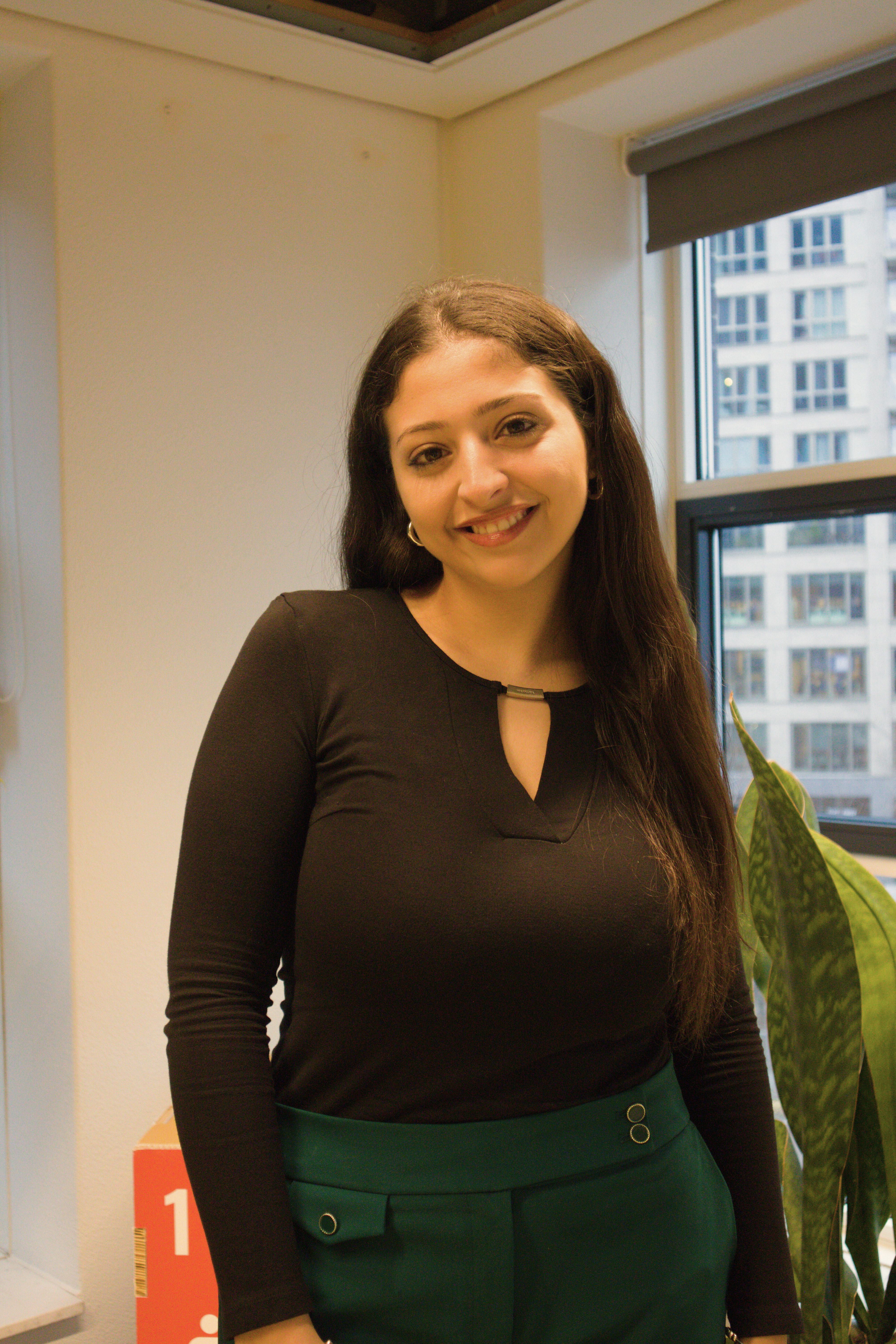
Galia Kademián at The Hague Humanity Hub
Our end goal? To make the world more livable—one person, one community at a time.
Find out more about Am-YAT See previous winnersWritten by Sacha Verheij